How to Play Stack
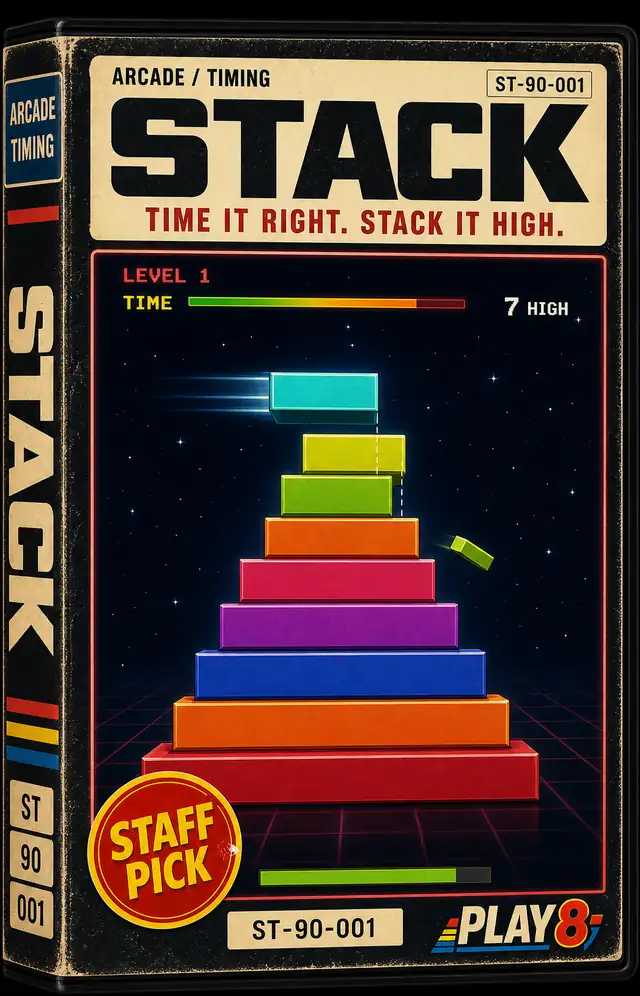
Stack is a one-button game about timing. A block slides back and forth above your tower, and a single tap drops it. Whatever part of the block overhangs the one below is sliced off and tumbles away; whatever overlaps becomes the new top of the tower, and the next block starts sliding at that narrower width. Every sloppy tap makes the target smaller for the rest of the level.
There is no penalty for a small mistake other than the width you lose, but a miss is fatal. If a dropped block does not overlap the block below at all, or the sliver that survives is only a few pixels across, the tower is finished and the run ends there. Land a block almost exactly on the one below, inside a margin of a few pixels, and it counts as perfect: nothing is cut off and the full width carries over.
The run is three levels and each one is a different speed problem. Level 1 needs eight blocks and starts slow. Level 2 needs twelve and starts faster. Level 3 needs sixteen at the highest starting speed and the tightest perfect margin in the game. Within every level, the slider also accelerates with each block you place, so the last few blocks of a level are always far quicker than the first. Each level allows three minutes, which is generous; speed, not the clock, is what ends most runs.
Controls
- Tap or click anywhere on the play area to drop the sliding block. There is nothing to aim and nothing to hold.
- The block is dropped at the position it occupies at the instant of the tap, so timing is the entire input.
- Landing within the level's perfect margin keeps the block at full width instead of trimming it.
- Two or more perfect drops in a row widen the block slightly, up to the original starting width.
- In full screen the view scrolls upward with the tower, holding the top of the stack around the upper middle of the screen.
Tips & Strategy
Tap early, not on target
There is a gap between deciding to tap and the tap registering, and the block keeps moving through it. That gap is roughly constant while the slider speed is not, so the amount you need to lead the block grows through a level. If your drops keep landing just past the mark, you are not tapping badly, you are tapping at the right moment for the speed you had four blocks ago.
Perfects are what buy the later blocks
A perfect drop preserves the full width, and two or more in a row actually widen the block back toward its starting size. That is the only way to recover lost width in the game. On level 3, where sixteen blocks are needed and the margin for a perfect is at its tightest, a couple of early perfects are often the difference between finishing the level and running out of block to aim at.
Choose which edge to lose
When you know a drop will be imperfect, it is better to be consistently late than to alternate between early and late. Trimming from the same side twice costs you the same total width as trimming both sides once, but it leaves the tower's usable edge in a predictable place, and predictability is what lets you find the perfect margin again on the next block.
Ignore the clock
Three minutes per level is far more than any level takes, so there is no reason to rush a drop. Watch a full sweep of the slider before your first tap on a new level to recalibrate to the new speed. The seconds you spend doing that cost almost nothing and the recalibration is worth several blocks of width.
Full screen is easier than the small frame
The same block covers more physical distance on a larger screen, which makes the moment of alignment easier to see even though the speed in game terms is unchanged. If you are trying to set a leaderboard score rather than kill thirty seconds, play the full screen version and let the camera follow the tower up.
Global Leaderboard
One score per run goes to the global board. Each level you clear is worth a hundred points for every block it required, so level 3 alone is worth twice what level 1 pays, and clearing a deeper level always outranks a flawless run on a shallower one. The level you fall on still pays half credit, scaled by how many of its blocks you had stacked before the miss.
Because a cleared level always takes exactly the same number of blocks, the tiebreak between players who got equally far is the share of those blocks you landed perfectly, worth up to an extra eight percent per level. Precision, not persistence, decides the top of this table.
The leaderboard keeps your best result rather than your most recent one, and each score is written to the weekly, monthly and all-time boards at once. You add a nickname of up to sixteen characters when you submit, and nothing needs to be installed or registered.
Frequently Asked Questions
Is Stack free to play?
Yes. It runs directly in the browser with no download and no account, and posting a score to the leaderboard only asks you for a nickname.
How many blocks do I need to clear a level?
Eight on level 1, twelve on level 2 and sixteen on level 3, with the slider starting faster on each level and accelerating as you place blocks.
What counts as a perfect drop?
Landing the block within a few pixels of the one below. The margin tightens as the levels progress, and a perfect drop keeps the block's full width instead of trimming it.
When does the run end?
When a dropped block misses the tower entirely or leaves only a sliver a few pixels wide. Running out of time also ends it, though the three minute limit per level is rarely a factor.
How is the score calculated?
Each cleared level pays a hundred points per block it required, plus up to eight percent more based on your share of perfect drops. A failed level pays half credit for the blocks you placed.
Can I get width back once I have lost it?
Only through perfect drops. Two or more in a row widen the block slightly, up to the width it started the level at, which is the game's only recovery mechanism.
Does it play the same on desktop and mobile?
Yes. The only input is a single tap or click anywhere on the play area, so a mouse, a trackpad and a touchscreen all behave identically.